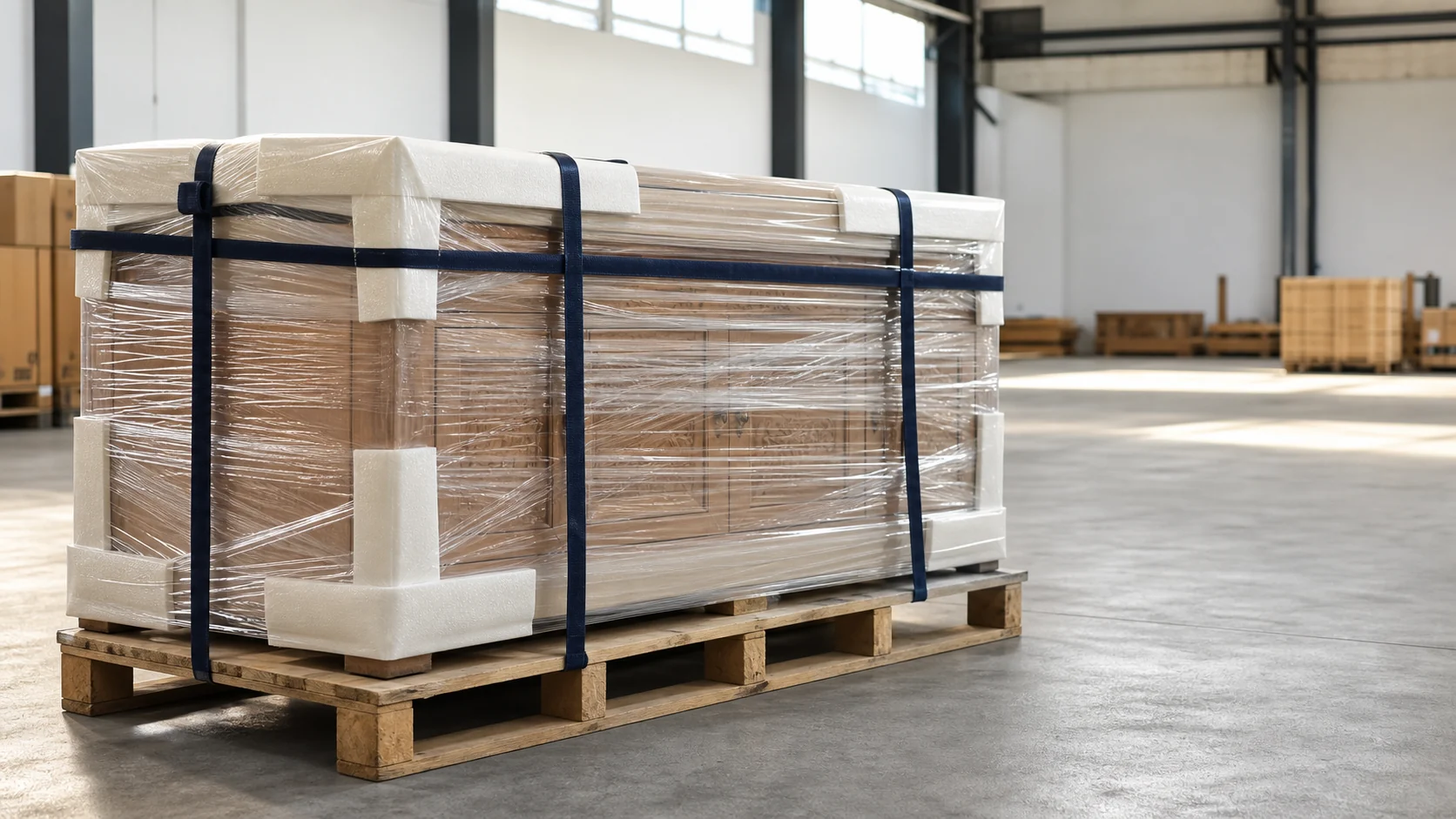
Handicrafts are the most damage-prone cargo leaving Bali. They are irregular in shape, often hand-finished, and rarely designed to be stacked. Packing them well is what separates a shipment that arrives sellable from one that arrives as an insurance claim.
Match the Method to the Material
Stone and Cement Carvings
Heavy, brittle, and unforgiving of point pressure. We wrap the carving in foam, brace it inside a timber crate so it cannot move in any direction, and keep the weight low and centred over the pallet base.
Woven Rattan and Bamboo
Light but easily crushed and highly sensitive to moisture. These go into rigid outer cartons with internal bracing so nothing rests on the weave, plus desiccant to control humidity across the transit.
Paintings and Framed Artwork
Face protection first, then a rigid sandwich of board on both sides, then a crate. Canvases are never packed flat under other cargo, and glass is either removed or taped and edge-protected.
Wood Sculptures
Protruding elements — arms, wings, headdresses — are the first thing to snap. We block around the protrusion rather than wrapping it tightly, so any impact is absorbed by the crate instead of the carving.
The Materials We Use
- Closed-cell foam and bubble wrap for direct contact with finished surfaces
- Corrugated corner guards on every edge
- Shrink film as a moisture and dust barrier
- Kiln-dried, ISPM-15 compliant timber for all crates
- Silica gel desiccant for organic and fibre-based items
Labelling and Documentation
Every crate is numbered and cross-referenced against the packing list. Fragile and orientation markings go on at least three faces, because you cannot control which way a crate is set down at a transshipment port.
A note on insurance: good packing dramatically lowers risk, but for one-of-a-kind or high-value pieces we still recommend all-risk marine cargo insurance. Ask us to quote it alongside the freight.